Trending

Most people get into tea the same way. You buy a bag of loose leaves, brew them in whatever mug is clean, and end up with something bitter, or watery, or both. Then you start browsing. Glass teapots, bamboo trays, brass tongs, a scale that measures to a tenth of a gram. Within an hour you have twenty tabs open and no idea which of them matter.
Here is the short version. Good tea needs three things done right: water at the right temperature, the right amount of leaf, and the right amount of time. Every accessory worth owning solves one of those three problems. Six tools will carry you for years. Everything else is optional, and most of it is decoration.
Before the details, here is the whole list. Own these six things and you can brew almost any tea reasonably well.
Notice what isn't on the list: no tea pets, no wooden tongs, no dedicated tea table. All of those are pleasant to own. None of them make your tea taste better.
Temperature is where most beginners lose the plot. Green and white teas brewed with furiously boiling water turn harsh and cooked-tasting, and the fix isn't a better leaf — it's cooler water. Black tea, most oolong and puerh, on the other hand, want water close to boiling. Brew those at 80°C and you get a cup that tastes like a memory of tea.
As a rough starting point: green and white teas around 75–85°C, lighter oolong around 85–90°C, darker oolong, black tea and puerh at or near boiling. Your own taste is the final judge, so treat those numbers as a starting line rather than a rule.
You don't need to replace it. Boil the water, pour it into a pitcher or a cold mug, and give it a minute or two before brewing. A cheap instant-read thermometer takes most of the guesswork out. A variable-temperature electric kettle is simply more convenient — you set 80°C, you get 80°C, every morning — and if you drink green tea daily, it's the one upgrade that shows up in the cup.
These two get confused constantly, so separate them in your head. The vessel is what you brew in. The infuser is what gets the leaves back out.
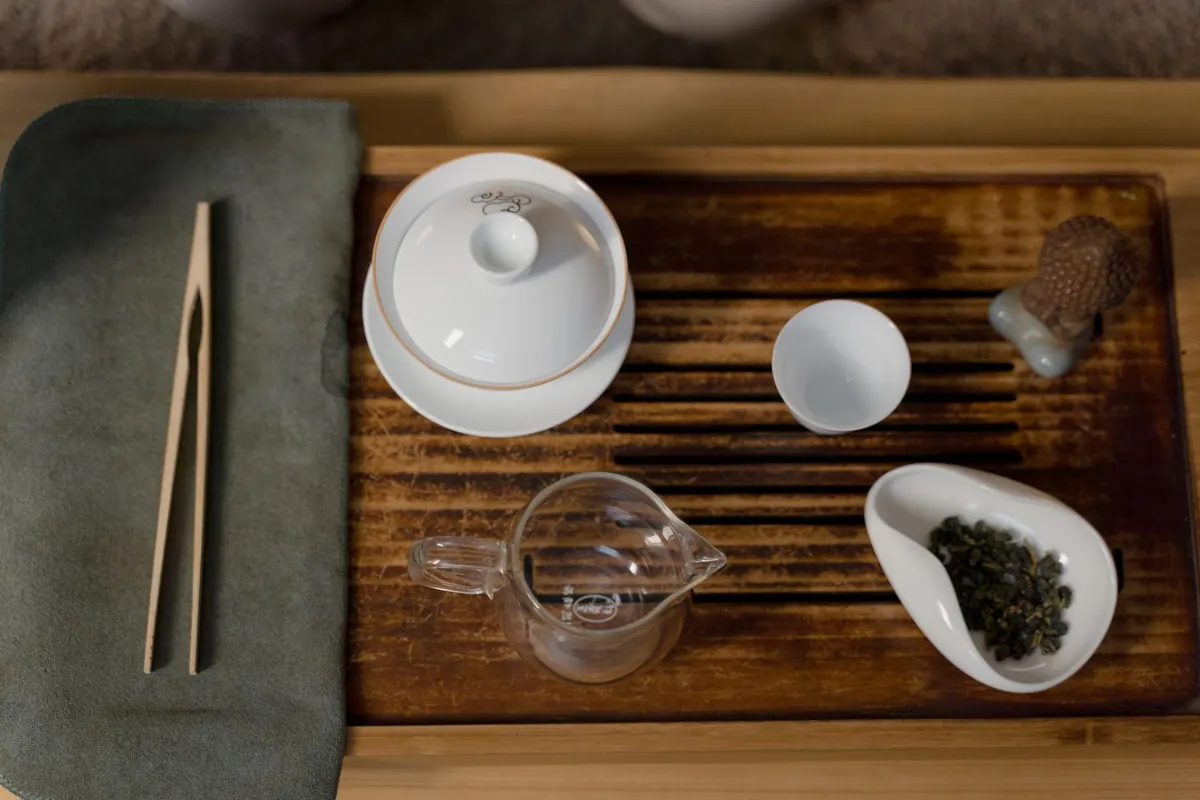
A teapot with a strainer built into the spout handles both jobs. A gaiwan, the small lidded bowl, does too once you get the pouring motion down, and it's the most flexible item on this list: any tea, any amount, and you can lift the lid to smell the leaves as they open. A plain mug works fine if you add a basket infuser that sits on the rim.
On infusers, one practical rule: give the leaves room. Ball infusers and narrow tea balls compress a spoonful of leaf into a space the size of a walnut, so some of it over-extracts while the middle stays dry. A wide basket with holes you can see through is better in every case.
Give the leaves room, and get them out of the water when the time is up. Those two habits matter more than the equipment.
Tea is brewed by ratio, and eyeballing leaf is the biggest source of inconsistency in a beginner's kitchen. A spoonful of fluffy white tea weighs a fraction of a spoonful of rolled oolong. A small digital scale removes the guesswork and lives happily in a drawer.
Start with roughly one gram of leaf per 100 ml of water for a mug-style brew — a 300 ml mug gets about three grams — and add more if the cup tastes thin. For gongfu brewing, with short repeated steeps in a small vessel, use considerably more leaf and much less water; five grams in a 100 ml gaiwan is a normal place to begin.
The timer matters just as much, because most people over-steep by walking away. Thirty seconds to a minute for a first gongfu steep, two to three minutes for a mug-sized brew. Taste a little before the timer goes off; bitterness arrives quickly at the end.
This one sounds like a joke and isn't. The cup changes how the tea tastes to you, mostly through heat. Thin glass loses temperature fast, so a delicate green tea in a cold glass mug can go flat before you're halfway down. Thick stoneware holds heat, which suits black tea and puerh. Somewhere in the 250–350 ml range is a comfortable default for mug brewing.
Shape matters less than feel. A mug with a pleasant lip that fits your hand, the one you reach for without thinking, will do more for your tea habit than any gadget here. If you dislike the cup, you'll drink less tea. That's the whole argument.
Don't buy all six at once. Buy in the order your tea actually needs.
Then stop and brew for a month. Take one tea and try it three ways: two grams, three grams, four. Steep it for a minute, then two. You'll learn more from that than from any new piece of equipment, and afterward you'll know exactly which tool you want next, if you want one at all.
One last thing: buy for the tea you drink now, not the tea you imagine drinking someday. A gaiwan you never use is just a bowl with a lid.
Photo: S R B S C A P E / Pexels